Dog Nail Trimming in Walnut Creek: The Click Test and When to Book a Standalone Visit
How fast dog nails grow, the simple click test, what long nails do to posture, and when to book a standalone nail trim in Walnut Creek.
Quick answer: Dog nails need trimming roughly every 3 to 4 weeks. The simplest test: if you can hear clicking on hard floors, they're overdue. Long nails affect posture, not just appearance.
Most dog owners know nail trimming matters. Fewer know how quickly things go sideways when it's skipped. Here are the actual numbers, the test you can run at home, and when it makes sense to add a standalone nail appointment between grooms in Walnut Creek.
How fast dog nails actually grow
The average is 1 to 2 millimeters per week. On a monthly basis, that's roughly a centimeter of new growth. For most dogs on a regular grooming schedule (every 4 to 8 weeks), that timing lines up. The problem is when appointments stretch to 10, 12, 14 weeks. That's when nails start causing real issues.
One thing that surprises people: pavement and concrete don't reliably file dog nails down. That's true for working dogs that spend hours on rough surfaces. A suburban Walnut Creek dog that does 30 minutes of sidewalk twice a day? Not enough contact time to make a dent. The nails still grow.
The click test — the simplest way to know
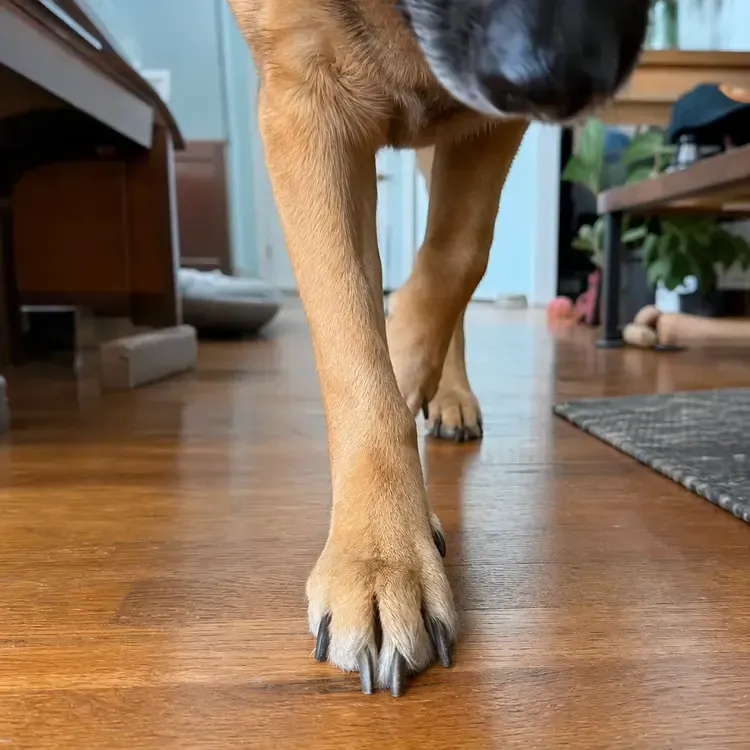
Walk your dog on a hard floor — wood, tile, or laminate. Listen for clicking. Clicking means the nail is long enough to make contact with the floor, which means it's past where it should be. A properly trimmed nail on a walking dog should be silent.
The visual version: look at the nail from the side when the dog is standing. If it extends past the paw pad and curves downward, it's overdue. This is the test I run at the start of every van session before I even pick up a clipper.
What long nails do to a dog's posture — more than you'd think
When nails hit the floor before the pad does, it shifts how the dog distributes weight. The dog compensates by rocking back slightly, which puts extra load on the hind legs and lower back. Over weeks and months, this creates muscle tension, joint strain, and in older dogs, it can worsen existing arthritis.
You can actually see it in some dogs with chronic long nails — they walk with a slightly hunched rear or are reluctant to sit. It reads as personality. It's usually nails. Vet bills for joint issues are expensive. Nail trims are not.
Breeds that need trims more often in Walnut Creek
Not all nails grow at the same rate. Some breeds need closer attention:
- Dachshunds — nails grow fast and the dog often resists clipping
- Basset hounds — thicker nails, harder to clip at home
- Greyhounds and whippets — thin, hooked nails that curl quickly
- Poodles and doodles — nails often obscured by foot fur
- Larger breeds (labs, goldens) — more growth before the nail is problematic
Between-groom nail care at home
Some dogs are fine with having their nails touched at home. For those dogs, a simple nail file (emery board or scratch board) between professional trims can slow the growth curve. Don't try to clip at home unless you know where the quick is — cutting into it hurts the dog and creates a negative association that makes every future nail trim harder.
For dogs that react badly to nail handling at home, the nail trimming and filing service in a professional setting is honestly the lower-stress option. A groomer who does this eight times a day is faster and more confident, and dogs pick up on that.

When a standalone nail trim between grooms makes sense in Walnut Creek
The math here is simple. If your dog's grooming schedule is every 8 to 12 weeks, nails typically need attention at the 4-week mark. A standalone nail trim is shorter and less expensive than a full groom. Worth it for dogs where the click test is already positive halfway through the grooming cycle.
| Grooming Interval | When Nails Need Attention | Recommended Approach |
|---|---|---|
| Every 4 weeks | Handled at each groom | No separate trim needed |
| Every 6 weeks | Week 4 click test | Home file if tolerated, or standalone trim |
| Every 8 weeks | Week 4-5 | Standalone trim at week 4 |
| Every 10-12 weeks | Week 4 | Standalone trim recommended |
| Irregular / infrequent | Immediately | Book groom + flag nail length upfront |
Nails are one of the easiest things to monitor and one of the most commonly neglected. Run the click test next time your dog walks past you on a hard floor. You'll know in about three seconds whether it's time.