Mobile Dog Grooming for Senior Dogs in Danville: A Gentler Way Through It
How mobile dog grooming in Danville works for senior dogs. Less stress, no cage time, kinder on joints. What to expect from the appointment.
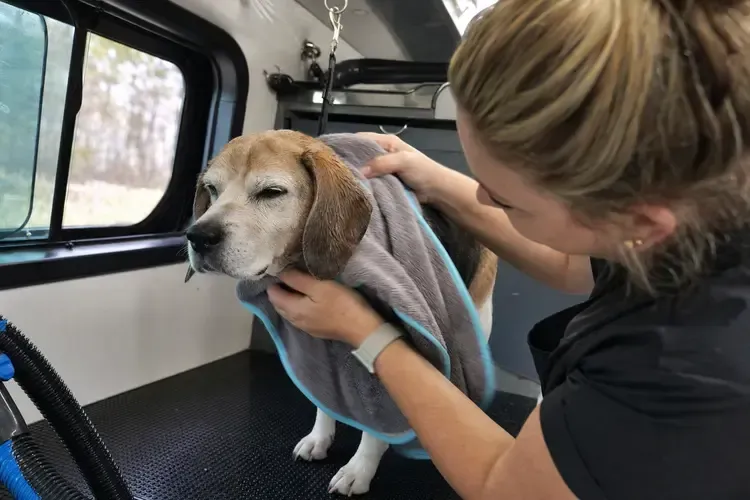
Last winter a thirteen-year-old beagle named Otis came on the van. He shook on the way up the ramp, his back legs slipping a little on the rubber mat. His owner stood at the door of the van the whole time, talking to him through the side window. Otis got a warm bath, a slow blow-dry, a nail trim sitting down, and went home in forty minutes. No cage, no waiting, no lobby full of barking. That is the case for
mobile dog grooming for senior dogs in Danville, and it's a real one.
Quick answer: senior dogs do better with mobile grooming because the appointment is one-on-one, no cage time, no waiting room, and the whole visit usually wraps in 30 to 60 minutes. Book a first visit during a calm time of day, not right after a long walk, and let us know about any meds or recent vet notes ahead of the appointment.
Why a 13-year-old beagle changed how we groom in Danville
Otis was not a hard groom. He was a hard ride. Two stairs into the salon, a wait in a kennel, the noise of seven other dogs. By the time he got on the table, his hips already hurt and his patience was gone. So we tried it the other way. We pulled the van into the driveway off Hartz Avenue. He walked up his own ramp. His person stayed close. The bath was warm, the dry was slow, and we let him sit on the grooming mat instead of standing the whole time.
He's been a regular for two years. That's the short version of what changed. The long version is that almost every senior dog in our books, from arthritic goldens to half-deaf terriers, does better when the salon comes to them.
What changes when a dog turns senior
Vets generally call a dog senior at seven for big breeds and ten for small ones. The body shifts. Joints ache, sometimes for the first time. Hearing dulls. Skin gets thinner and bruises more easily. A lot of seniors develop benign skin tags or fatty lumps that you have to groom around, not over. And the nervous system slows, which means new noises take longer to fade. A blow dryer that a young dog ignored at three is suddenly a problem at eleven.
None of this means your dog stops needing grooming. The opposite. Senior coats mat faster, nails curl into the pads, and a missed bath turns into a skin infection quicker than it used to. The grooming has to keep happening. It just has to happen gentler.
What a senior-friendly Danville appointment looks like
We grout the day differently for older dogs. Shorter standing time. More breaks. A quieter dryer setting. And we do the noisier stuff (clipping, the high-velocity dryer) only after the dog has settled. A first-time senior client usually books a calm window, mid-morning or early afternoon, and we keep the van running on its quietest mode.
Here's the rough difference between a salon visit and a
Danville mobile bath package for a 12-year-old dog. Real numbers, not best-case.
| What it looks like | Salon visit | Mobile in your driveway |
|---|---|---|
| Total time at the appointment | 3 to 5 hours | 30 to 60 minutes |
| Cage or kennel waiting time | Yes, sometimes 2 hours | None |
| Other dogs in the room | 5 to 12 | Zero |
| Owner can stay during groom | No | Yes, by the side window |
| Pickup walk for senior joints | Lobby and parking lot | Door to driveway, ramp |
| Recovery time at home after | Often 6 plus hours sleep |

Coat and skin: the part most owners miss
Senior skin is the quiet thing that owners don't notice until it itches. Drier than it used to be, slower to heal, more reactive to harsh shampoos. We almost always swap to a fragrance-free or oatmeal formula for dogs over ten, and we follow with a light conditioner so the coat doesn't strip. If your dog has a known allergy or a medicated wash from the vet, we use that instead. The wrong shampoo on a senior is what turns a normal bath into a week of scratching.
What we look for during a senior groom, every visit:
- Skin tags or new lumps that weren't there last time (we mark them and tell you)
- Mats forming behind the ears, in the armpits, and at the rear sanitary line
- Nails growing into the pads, especially the dewclaws, which seniors stop wearing down
- Ear wax buildup or a new smell, which can mean an infection
- Eye discharge that is more than the usual morning gunk
- Bare patches or thinning, especially on the belly and inner thighs
If we see something that looks vet-shaped, we stop and tell you. Not in a text three days later. Right then, while you're standing at the van. That's one of the small advantages of a one-on-one appointment with premium shampoo bath service: nothing gets buried.
How often, and when to call the vet first
Most senior dogs in Danville do well on a four-week or six-week schedule. Long-coat breeds (poodles, shih tzus, doodles) need the four-week. Short coats can stretch to six. Going beyond eight weeks is when we start seeing the avoidable problems, especially mats that pull on the skin during a bath.
There are a handful of times we ask owners to talk to the vet first, before the appointment, not after.
- A new heart murmur or recent collapse. The dryer can be too much stress.
- Active seizures or a recent change in seizure meds.
- Untreated severe matting, where the mats are tight to the skin. That's a vet sedation case, not a groom.
- An open wound or hot spot. We need it healed or covered first.
- Suspected hearing or vision loss that hasn't been checked. We can still groom, we just adjust everything.
We don't sedate. We won't groom a dog who is in active pain. And we will absolutely call you mid-appointment to stop if a dog tells us they're done. That's the deal.

How we set the van up for a senior dog before the bath even starts
There is a five-minute setup that happens before a senior dog ever steps on the table, and it changes the whole visit. The grooming mat goes on the floor of the van for stiff hips. The HVAC sits on a low fan setting so the air movement is steady but quiet. We swap the standard nylon noose for a softer figure-eight harness so a senior with a sore neck never feels yanked. Treats sit at the front of the table within reach, and the high-velocity dryer stays off until the dog has settled. Most seniors give us a small sigh in the first two minutes once they realize the table isn't going anywhere and there is no other dog in the room. That sigh is the signal we are ready to start. The salon version of this dog is a kennel, a wait, and a rushed table. The senior gets the slow version, every time, and it shows up in how they walk back into the house after.
Booking your senior dog's first visit
If your dog is over ten, or has slowed down in the last year, the easiest first step is a phone call before you book online. Tell us the breed, the age, the last time they were groomed, and any meds. We'll match you with a slot that's quiet, set the van up for low-stress, and walk you through it before we pull into the driveway. The first appointment usually takes about ten minutes longer than a regular one. Worth it. We'd rather start slow than start over.
Senior dogs are the reason this job matters. They've earned the gentle version of the bath. Bring them in, on their own driveway, and let them sleep in their own bed after.